
The fundamental controllers of the circuits are the switches. They regulate the current flow and keep your power supply running in residential or commercial sectors.
Among switches, you might have observed two words— throws and poles. Do you want to know what they are?
Today, we will take you through the definition, types, and identification methods of poles and throws.
What are poles?
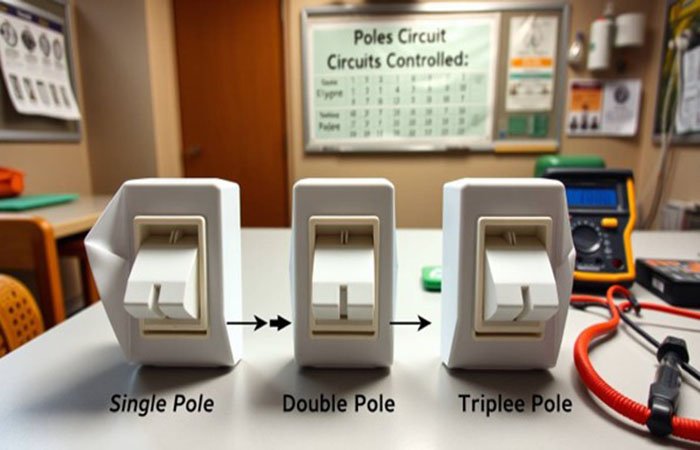
Pole is the number of circuits under a switch. For example, you have a switch that controls only one circuit. It is a single pole. If you increase the circuits to two, it will become a double pole.
Types of Poles
There are several numbers of switch poles. We have discussed the three most common ones.
Single Pole
A single pole is a basic and straightforward switch that connects and disconnects live wires without touching the ground or neutral wires. Single-pole switch controls one circuit. Single-pole switches are ideal for simple devices like lights.
Double Pole
A double pole switch flows electrical supply through two different circuits simultaneously. In contrast to a single pole, 2 pole switch deals with the neutral wires and live wires. This switch has applications in industrial sectors and 240V voltage devices.
Triple Pole
A triple-pole circuit is a complicated switch that controls three circuits simultaneously. It is often helpful for large generators and complex machines.
What are throws?
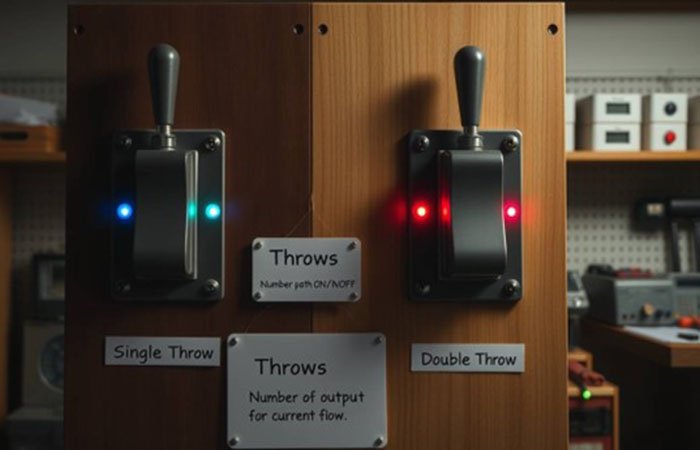
A throw means the number of routes for electricity in a circuit. Sometimes, there can be a single pathway for a single throw switch. The number of pathways depends on the number of throws.
Types of Throws
There are two types of throws based on the electrical flow.
Single throw
There is one pathway for electricity. Imagine an example of a light control with a single-pole switch. Toggling the switch lets current flow from the switch to the light. Once you disconnect, there is no flow because the single pathway is now disconnected.
Double throw
In a double-throw switch, there are two outputs. The current flows through two different pathways. Flipping the switch can decide the current path.
Here is an example of a fan that throws air forward and backward. One throw sends the air in the forward direction, while the other can send it in the reverse direction.
Types of Poles and Throws Switch Combination
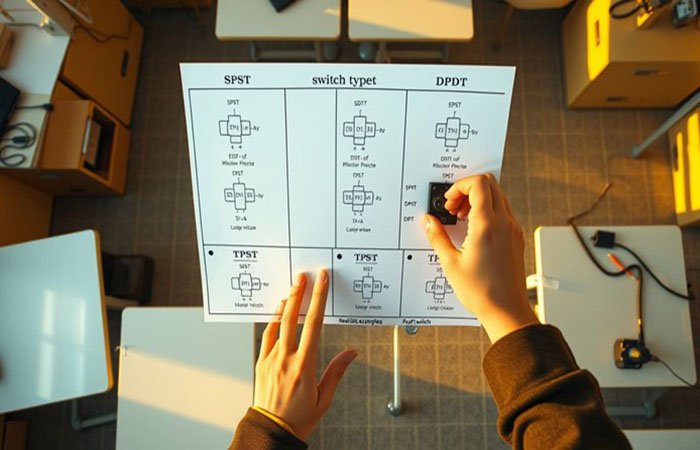
If you combine the poles and switches, you get the six most common combinations.
SPST
It is a traditional circuit often used at home for simple control. It includes one input and one output. When you push the switch and turn it on, it controls a single circuit and operates the device. Turning off the switch turns off your device.
SPDT
One input but two outputs— it is the magic of a single-pole double-throw switch. Compared to SPST, this switch provides electricity to two circuits.
Flipping a switch in one direction can operate one circuit, and flipping it in the opposite direction can operate another circuit. This switch is often helpful in audio speakers.
DPST
Four terminals— two inputs and two outputs. It is the double pole switch. With a single throw, you can simultaneously control both circuits with a single toggle of the switch.
Such a switch is useful in thermostats and industrial applications.
DPDT
It is a complex switch having six terminals. There are two inputs to control four outputs. Each input has two outputs and controls one circuit. Overall, you can simultaneously operate the two circuits with a double pole double throw switch.
3PDT
What if there are three circuits and two paths? Well, a triple-pole switch is here. It has nine terminals: Three inputs and two output terminals. Each input controls a single circuit.
Such a circuit is complex and is often used in advanced technology and automation machines.
Step-by-step Guide to identify a pole and throw
A combination of poles and throws can be confusing. Therefore, you can identify the pole and throw it into a circuit by the following steps.
Step 1: Review datasheet
You can review the datasheet online to see if you have the part number of the switch. Many manufacturers often provide:
- A labeled pin diagram
- Internal wiring diagram
- Other details like voltage and current
This method doesn’t require you to test with a multimeter or exert any physical effort.
Step 2: Use a multimeter
A multimeter can give an idea about the different combinations of the poles and terminals.
Here is how you can check.
- Keep your multimeter in the resistance or continuity mode to test the flow of current.
- Flip the switch and check the current between the terminals.
- Again, flip the switch and check the current between the terminals. If the multimeter shows a current reading, it means the switch is double-throw. Otherwise, it is a single throw.
- Try all the possible combinations between different terminals to know the correct number of poles and throws.
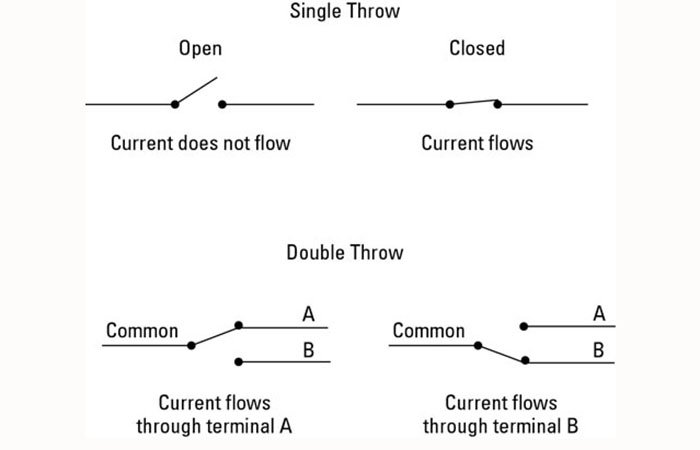
Step 3: Visual symbols
Sometimes, the switches come with visual symbols. All you have to do is decode those symbols and define the number of poles and throws it has.
Here is how it differs.
- A line and a dot show a single pole and single-throw switch.
- A switch flipping between two lines means a single pole with two throws.
FAQs
- Can I Use A DPDT Instead Of An SPDT?
Yes. A double pole double throw switch gives an added functionality compared to a single pole double throw switch. You can control two different circuits flawlessly.
- Is throw the same as a toggle?
No. Toggle refers to turning on or off a switch. On the other hand, a throw tells the number of pathways through which current flows.
- What is the difference between 3-way and 4-way switches?
A 3-way switch tells you about the two locations from which you can control your electricity supply. A 4-way works with a 3-way switch and often controls the power supply from three or more locations.
Conclusion
Whether you are doing home wiring or building a circuit for your devices, understanding poles and throws is 100% crucial. It helps decide on the number of poles and throws you should go for.
 Russia
 English