
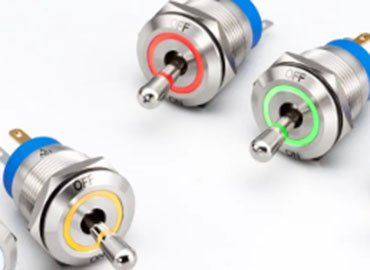
Among many control electronic devices, two-way toggle switches are widely favored for their convenience. They control the connected lights or devices from two locations instead of one.
In many regions, they are referred to as three-way switches. While the wiring may appear complex, it is actually straightforward.
Understanding basic terminals and wiring methods, along with essential tools, is necessary. Today, we will discuss how to connect a two-way toggle switch to your devices.
What Is A Two-way Toggle Switch? How Does It Work?
A two-way toggle switch controls lighting from two different locations. It enables current to flow through the circuit in two directions, thereby achieving this functionality.
The working principle of a two-way toggle switch is as follows.
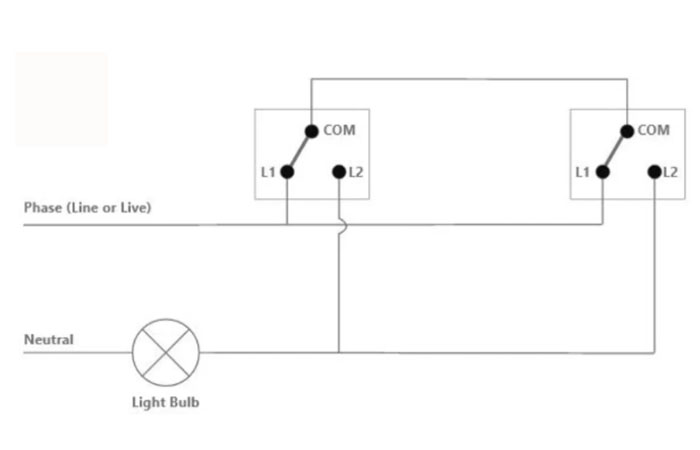
- It consists of one common terminal (COM) and two routing terminals (L1 and L2).
- COM is the common terminal that allows power to flow.
- L1 and L2 are pathway terminals that direct the current flow.
The toggle switch can alter the current path to control the on/off state of the lighting system.
Tools and Materials Required
Before connecting the toggle switch to your lighting system, the following tools are required, along with their key functions.
- Screwdrivers and pliers – For tightening screws and handling wires.
- Wire stripper and cutter – To remove insulation and trim wires.
- Voltage tester or multimeter – Used to check live circuits and ensure safety.
- Two two-way switches – The primary control components.
- Electrical box and cables – To house the switches and complete the circuit connections.
- Safety gloves and goggles – For personal protection when working with electricity.
Step-by-step Guide to Wiring A Two-way Toggle Switch
Once you have the appropriate tools and have connected the wires, follow these steps to complete the two-way toggle switch wiring process.
Step 1: Identify COM, L1, and L2 Terminals
The switch has three terminals: COM, L1, and L2. Check the back of the switch for labels and markings. If no markings are present, refer to the manual to identify the correct terminals for proper connection.
Step 2: Connect The Live Wire to The COM Terminal on The First Switch
COM is the standard terminal through which current flows. Make the first connection here by linking the live wire to the COM terminal.
Step 3: Link Traveler Wires between L1 and L2
L1 and L2 are traveler wires and are not intended for live wires. Connect the L1 traveler terminal of one switch to the L1 terminal of the second switch using cables. Repeat the same process for the L2 terminals of both switches.
Step 4: Connect The Load Wire to The COM Terminal on The Second Switch
Connect a new wire to the COM terminal of the second switch, and attach the other end of the wire to the live terminal of the light fixture.
Step 5: Secure Connections and Install Cover Plates
Tighten all connections and cover the systems. Carefully place them into the electrical box to ensure the safety and stability of the electrical system.
Step 6: Test The Circuit for Proper Functionality
Do not skip this step. Turn on the power source and check the current flow and light control. Verify that the COM, L1, and L2 terminals are functioning correctly, enabling proper dual light control.
Common Wiring Mistakes to Avoid
During DIY wiring, people often make critical yet simple mistakes, leading to system failure. Here are some mistakes to avoid.
Failure to Turn Off Power Before Wiring.
Before making connections, ensure the power supply is turned off. Otherwise, accidents may occur due to live current. However, you can use a voltmeter or multimeter to confirm that the power is off.
Incorrect Connection of Traveler Wires
L1 and L2 are traveler wires and are crucial. Incorrect connections can disrupt the entire power supply system. Therefore, connect the L1 terminal of one switch to the L1 terminal of the other, and do the same for the L2 terminals.
Loose Connections
Loose connections can cause accidents, such as short circuits or flickering lights. Use screws and ensure they are tightened securely.
Incorrect Wire Gauge
Incorrect wire gauge is a primary cause of light overheating. Always select a compatible and appropriately sized wire gauge.
Omission of Ground Wire
A ground wire ensures safe connections. In modern electrical systems, ground wires are essential. Never omit the ground wire to maintain a safe wiring system.
Skipping Post-Installation Testing
After connecting the wires, the most critical task remains: testing the system. If errors are detected, reconnect and correct the wiring.
FAQs
1. Does it matter which wires go on which terminal in a two-way switch configuration?
Yes, it matters. The live wire should be connected to the COM terminal to allow power flow.
2. How does a two-way toggle switch differ from a single-pole switch?
A single-pole switch is a simple plug-and-play system that controls devices from one location. Wires can be connected to any terminal. In contrast, a two-way toggle switch requires careful cable placement and controls lighting from two locations.
3. How do I identify live and neutral wires before wiring?
You should use a voltage tester or multimeter. A live wire has the current and shows the reading, while a neutral wire completes the circuit.
Can I wire a two-way switch for controlling outlets instead of lights?
Yes. You can control outlets instead of lights, but ensure proper wiring on the correct terminals to avoid mishaps.
Conclusion
A two-way toggle switch is a simple setting when you identify the terminals. Before making connections, always turn off the power. Use a multimeter or voltmeter to measure the current flow.
Once you link the terminals, always test the system for wiring accuracy.
 Russia
 English