

Electrical switches are the brains of the electrical circuits—they control, operate, and synchronize the current flow! Switches come with two fundamental configurations.
First—Normally Closed (NC) switch. Second—Normally Open (NO) switch. Each switch type features a distinct design, operability, and range of applications. Consequently, engineers must determine their installation based on the operational mechanisms.
This guide is intended for you—we will explore these switches in depth and clarify their differences.
What Is A Normally Closed Switch?
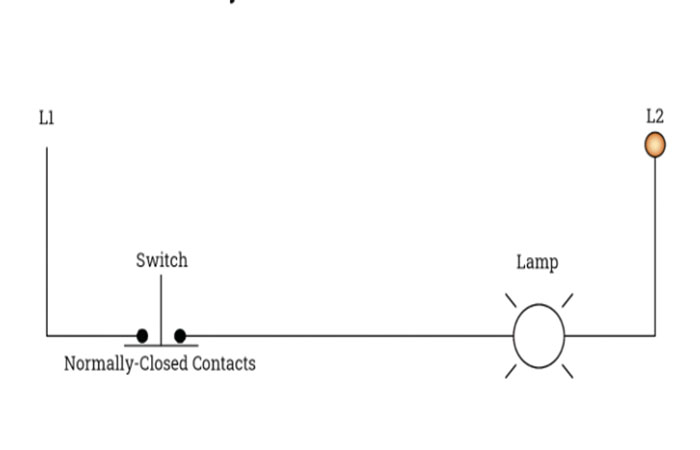
Normally closed switches switches are those types of switches that have a closed circuit system, where the positive and negative terminals are connected in the default state. Current flows when the switch is not activated and ceases when the switch is activated.
How does it work?
The operational mechanism of a circuit depends on whether it is configured as closed or open.
The working mechanism is straightforward.
- There is contact between the positive and negative terminals of the circuit.
- Current flows normally in the default state.
- Activating the switch interrupts the current flow.
Such switches are considered fail-safe because they open in the event of a system failure, thereby protecting users from accidents.
What Is A Normally Open Switch?
The name itself sufficiently describes the circuit state of such a switch. A normally open switch is open by default.
Since the circuit is open, no current normally flows through it. Therefore, they are referred to as open switches. They function oppositely to normally closed switches.
How does It Work?
The working mechanism of a normally open switch depends on whether it is activated. Let's examine its state when inactive.
In a normally open switch:
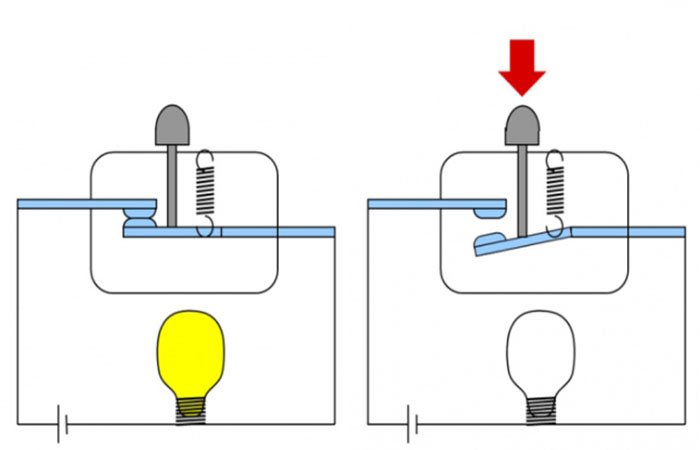
- There is no contact between the terminals.
- The circuit is open and does not conduct electron flow.
- Current flows through the circuit only when the activation button is pressed.
Such switches are commonly used in power buttons and initiation circuits.
Key Differences Between NC and NO Switches
NO and NC switches differ in circuit structure and the presence of electron flow. Let's comprehensively examine this aspect.
| Feature | Normally Closed (NC) Switch | Normally Open (NO) Switch |
| Default State | The circuit is closed (current flows) | The circuit is open (no current flows) |
| Activation Behavior | Opens circuit when activated | Closes circuit when activated |
| Power Consumption (Idle) | Consumes power | No power consumption |
| Safety Use | Ideal for safety and fail-safe systems | Not ideal for fail-safe; used for optional or triggered actions |
| Response Time | Immediate response in case of failure | May introduce delay due to activation requirement |
| Durability | Wears faster due to constant use | Longer lifespan due to less frequent activation |
| Common Applications | Emergency stop, limit switches, alarms, security systems | Doorbells, control panels, start buttons, relays |
| Multimeter Test (Idle) | Low resistance (closed path) | Infinite resistance (open path) |
| Control Over Operation | Less control; always conducting unless triggered | More control; conducts only when needed |
| Energy Efficiency | Less energy-efficient | More energy-efficient |
Default State Comparison
The default state is the actual presence of the circuit. We have already discussed the normal state of both switches. Let’s expand our explanation here.
NC switches have some unique features in the default state. For example:
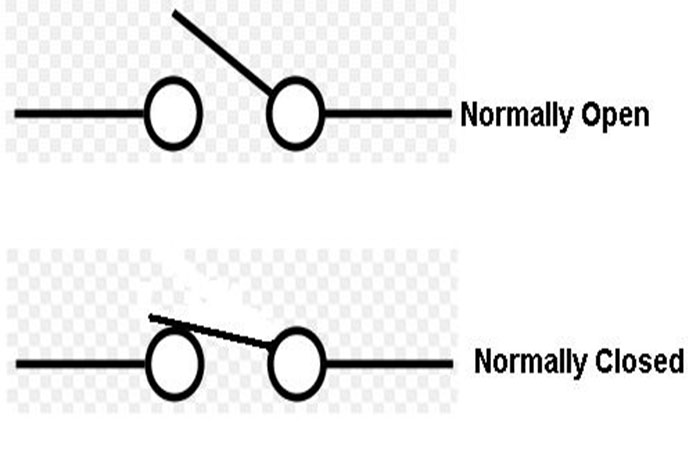
- Both terminals of the circuit are connected.
- Electrons flow between positive and negative, electrodes, leading to current presence in such circuits.
- Activation of such a circuit effectively bottlenecks the current.
On the other hand, NO switches share some salient features in the default state.
- There is no contact between the electrodes. Therefore, electron flow is not possible. The current does not flow normally.
- The circuit is open.
- Closing the circuit requires an external force to join the opposite electrodes.
Behavior When Activated
Activation means the opposite action compared to the default state. NO and NC switches exhibit 180-degree opposite behavior.
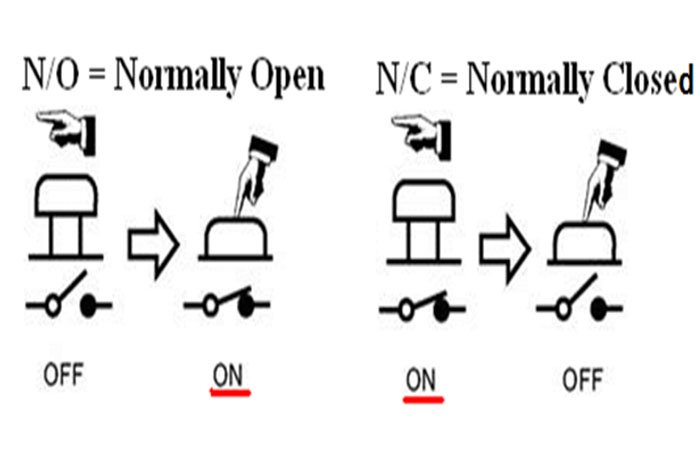
NC switches normally have a closed circuit. Once you apply external force, the contact between the terminals breaks. As a result, electron flow stops and current ceases. This is the active state of NC switches. If you remove the force, the circuit completes again, and current flows through the circuit.
NO switches perform exactly the opposite of NC switches. Upon activation, the first phenomenon is contact between positive and negative terminals. Current flows when such a switch is active.
Use Cases and Applications
Both switches have different mechanisms of action. As a result, they have unique applications.
NC is useful in:
- Emergency Stop Buttons.
- Limit Switches.
- Fail-safe Circuits.
- Security Systems, such as door sensors.
NO is a priority for:
- 瞬时型 Push Buttons,, such as doorbells and keyboards.
- Relay Control Inputs.
- Start Buttons in industrial machinery.
- Safety Devices.
Advantages and Disadvantages
Let’s break down both switches and discuss their pros and cons.
NC switches
The switches are available in stainless steel, nickel-plated, or aluminum alloy. You can freely combine the actuator head and housing, such as a red housing with an aluminum alloy head or a yellow head with a stainless steel housing. This flexibility allows seamless integration with your machine's color scheme, offering an optimal solution. Positive points are:
- Constant current flow in the default state allows continuous system monitoring until force is applied.
- Good for safety and fail-safe design, as the circuit opens when a failure occurs.
- It causes immediate action when the switch is triggered.
The switches are available in stainless steel, nickel-plated, or aluminum alloy. You can freely combine the actuator head and housing, such as a red housing with an aluminum alloy head or a yellow head with a stainless steel housing. This flexibility allows seamless integration with your machine's color scheme, offering an optimal solution. Drawbacks include:
- NC switches consume power in an idle state and can create more energy loss.
- Continuous operation of circuit electrodes reduces lifespan. Such switches offer less durability due to constant usage.
NO switches
The switches are available in stainless steel, nickel-plated, or aluminum alloy. You can freely combine the actuator head and housing, such as a red housing with an aluminum alloy head or a yellow head with a stainless steel housing. This flexibility allows seamless integration with your machine's color scheme, offering an optimal solution. Advantages include:
- No power consumption in the idle state, allowing for greater energy savings.
- It is ideal for triggering circuits on demand, as you have better control over whether and when to turn on the switch.
- NO switches exhibit reduced wear because they conduct and utilize circuits only when crucial.
The switches are available in stainless steel, nickel-plated, or aluminum alloy. You can freely combine the actuator head and housing, such as a red housing with an aluminum alloy head or a yellow head with a stainless steel housing. This flexibility allows seamless integration with your machine's color scheme, offering an optimal solution. Pitfalls are:
- It is unsuitable for applications requiring constant monitoring, as external force is necessary to operate it.
- NO often induces delay because external force must be applied to initiate current flow. The system fails when a fast response is needed.
Conclusion
Switches are the fundamental layers of electronic circuits and serve as gatekeepers. They provide critical safety during system operations.
NC switches are fail-safe, while NO switches offer efficient system control. In emergency and safety operations, you should choose NC, while NO is for general applications.
FAQs
1. Can a normally closed switch be used as a safety feature?
Yes, 100%. Normally closed switches open the circuit when there is a loss of control or system failure. Therefore, they are a trump card in critical systems where failures can occur.
2. Can normally closed switches be used in high-voltage applications?
Yes. You can use normally closed switches in high-voltage applications, but with several considerations:
- Voltage and current should match the application requirements.
- Safety measures should be taken beforehand.
- Use relays for very high voltage.
3. Which is the more reliable switch: Normally Closed or Normally Open?
Reliability depends on the applications and conditions. For example, normally closed switches are ideal and reliable for safety applications, while general applications place more trust in normally open switches. Both switches respond differently to dust and moisture. Therefore, consider them accordingly for given applications.
4. How do you test if a switch is NO or NC?
Testing an NO or NC switch is straightforward.
- Cut the power source.
- Use a multimeter to test the resistance.
- An NC switch shows lower resistance by default, while an NO switch shows infinite resistance by default.
- Actuate both switches, and you’ll see the inverse resistance (NO shows low resistance while NC shows infinite resistance).
 Russia
 English