
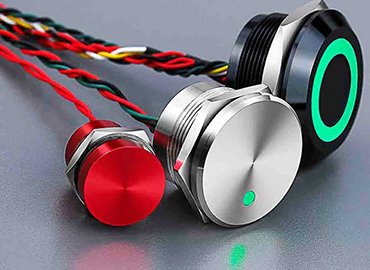
Do you really understand piezo switches? Piezo switches are a special type of push button switches. Whether you are a novice in this industry or an expert who knows a lot about switches, I hope this article can give you more inspiration. What Is A […]
What Is A Piezo Switch?
First of all, we need to understand what PIEZO or PIEZOELECTRICITY is.
The piezoelectric effect was discovered by French physicists Pierre Curie and Jacques Curie in 1880. This effect only occurs in some crystal materials with non-centrosymmetric structures, such as piezoelectric ceramics, quartz crystals, etc. When an external force is applied, an electric charge is generated on the surface of the material, thus forming an electrical signal. This is the positive piezoelectric effect. Conversely, when an electric field is applied to these materials, mechanical deformation occurs. This is the inverse piezoelectric effect.
The piezoelectric effect is actually utilized in very common devices, such as piezoelectric sensors, ultrasonic equipment, ignition devices, and piezoelectric switches.
Generally speaking, a push button switch usually requires a certain amount of mechanical force to press, and the internal structure—spring, double gold and silver point contacts—closes the circuit to make the switch operate, while the piezo switch mainly controls the on and off of the circuit by generating charges in the piezoelectric element under the action of external force.
In short, the piezo switch is an electronic component based on the piezoelectric effect, which has a longer lifespan, is safer, and has higher efficiency than ordinary push button switches.
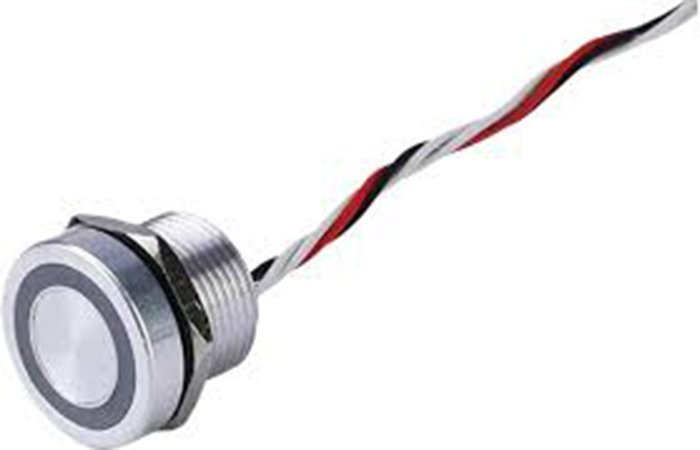
Advantages and Disadvantages of Piezo Switches
Advantages of Piezo Switches
Compared with push button switches, piezo switches have their own advantages and are becoming increasingly popular in practical applications.
High Sensitivity: The piezo switch operates using the charge generated by contact. The contact head has high sensitivity and can detect the charge generated by slight pressure, thereby activating the switch.
Long Electrical Life: Piezo switches can be operated with just a light press, and there is no movable key head that needs to be pressed, so there is no mechanical wear, which slows down the aging of components and greatly extends the electrical life of the switch.
Low Power Consumption: Piezo switches do not require electrical energy, and only a simple press is needed to generate an electric charge, which significantly reduces the power consumption of the switch.
High Reliability: The integrated design converts external mechanical pressure into signals, ensuring accuracy and high responsiveness.
Diverse Functions: The unique performance of piezo switches makes them suitable for use in many industries with a wide range of applications. They can be used for sensing functions, environmental monitoring, feedback functions, etc.
Strong Adaptability: The improvement of IP rating enables piezo switches to work normally in extreme environments. Under some special conditions, only piezo switches can start and shut down equipment normally, thereby improving social productivity.
In short, piezo switches have many advantages, which is why they can be used in various industries. These advantages can help switches improve efficiency, reduce accidents, and ensure safety during use.
Disadvantages of Piezo Switches
Piezo switches are known for their durability and robustness, but there are still some drawbacks.
High cost: Piezo switches are often 2-3 times more expensive than regular button switches due to complex production.
Low sensitivity: Piezo switches require firm pressure and are not suitable for light-touch scenarios.
Temperature Sensitivity: Piezo switches do not perform well at extreme temperatures. If the temperature is too high, their power generation becomes weaker; if the temperature is too low, they may become brittle and prone to cracking. Both conditions may cause unstable signals.
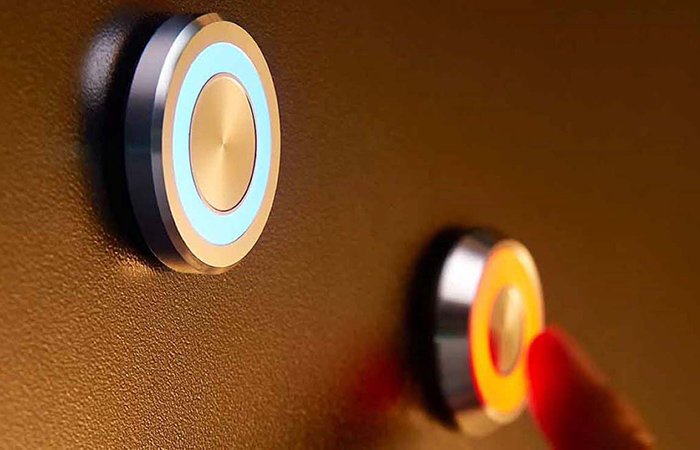
Types of Piezo Switches
By Material
Stainless SteelRobustness:.
Stainless steel is resistant to corrosion and fogging, making it well-suited for use in harsh environments. It has a longer lifespan than switches made of other materials. Plastic:.
Plastic is lightweight and easy to press. It is excellent for indoor use, especially for office equipment and household appliances. Aluminum Oxide:.
By Function
Anodized aluminum comes in various colors like red, green, black, and gold. It is the best choice for damp locations such as cargo ships, yachts, and swimming pools.Momentary Piezo Switch:.
This type of switch activates when pressed and turns off when released. It is commonly used in elevators for quick shut-off.Latching Piezo Switch:.
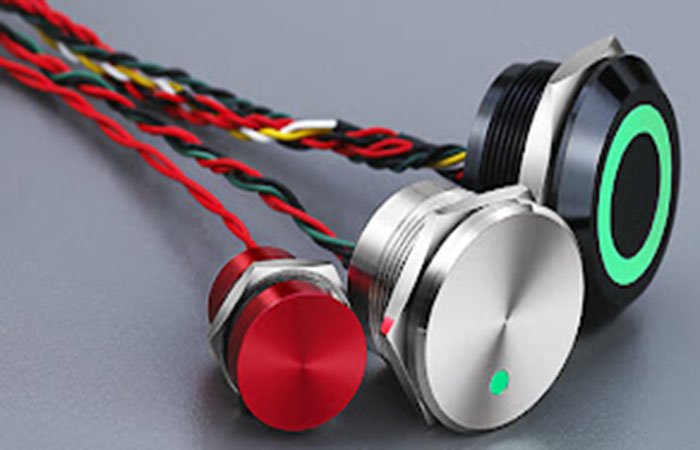
What Are Piezo Switches Used For
Stays on or off until pressed again to reset. Widely used in devices like light switches that require sustained operation.
The powerful functions and features of piezo switches can be applied to various industries. Common industries include: Ships:.
The high IP characteristics and high sealing performance (IP69K) of piezo switches make them widely used in ships and underwater equipment, such as yachts and diving equipment. Household Appliances:.
Piezo switches have the advantages of low power consumption and fast response speed, so they can be used in some household appliances and also for smart home control, such as smart lighting, security systems, etc. Industrial Automation:.
Piezo switches have no mechanical wear, higher durability, and high sensitivity, so they can be used in mechanical control, production lines, etc., to reduce errors and improve production efficiency. Medical Equipment:.
Automobile Aerospace: Piezo switches are primarily used in control panels of high-speed trains, aircraft, and other components. They feature fast response times and high reliability, ensuring operational safety.
Environmental Monitoring: The high sensitivity of piezo switches enables them to detect even the slightest changes, making them ideal for monitoring applications such as weather stations and pollution monitoring equipment.
In summary, piezo switches can be found across various industries.

How Does A Piezo Switch Work
The operation of a piezo switch is based on the piezoelectric effect, therefore how a piezoelectric switch works can also be understood as the working principle of the piezoelectric effect.
The piezoelectric effect refers to the generation of an electric charge, and consequently an electrical signal, when a piezoelectric material is subjected to external force. This process is bidirectional; the generation of an electrical signal can also cause mechanical deformation in the piezoelectric material. These are the two manifestations of the piezoelectric effect: the direct piezoelectric effect and the converse piezoelectric effect.
The direct piezoelectric effect means that when a piezoelectric material is subjected to external force, its internal structure undergoes slight deformation, causing internal charges to redistribute and generate a potential difference, thereby producing an electrical signal detectable by a circuit.
The converse piezoelectric effect involves the interaction between the charges within the piezoelectric material and an external electric field, leading to mechanical deformation of the material's internal structure.
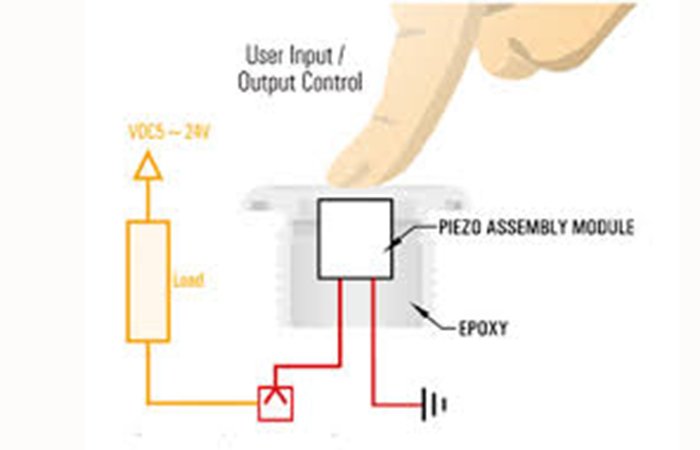
The working principle of a piezo switch involves three steps. First, when external pressure is applied to the piezoelectric material, an electric charge is generated within the material—this is the mechanical pressure effect. Second, the charge separation generates an electrical signal. Third, the circuit detects this electrical signal once it reaches a certain threshold, triggering the switch and completing the operation.
How to Wire A Piezo Switch
Many people think wiring a piezo switch is complicated, but it's much simpler than you might imagine. I will outline the detailed wiring steps so you can DIY it at home. First, you will need two wires: one red and one black. Connect the red wire to the power source and the black wire to the device you wish to control. You can also place a resistor between the switch and the control board to enhance safety, preventing signal overload. If installing the piezo push-button switch in a factory environment, be sure to use shielded cable to avoid electromagnetic interference from other equipment disrupting the piezo switch. If installing at the seaside, use waterproof and rust-proof stainless steel connectors to effectively extend the piezo switch's lifespan.
How Long Does A Piezo Switch Last
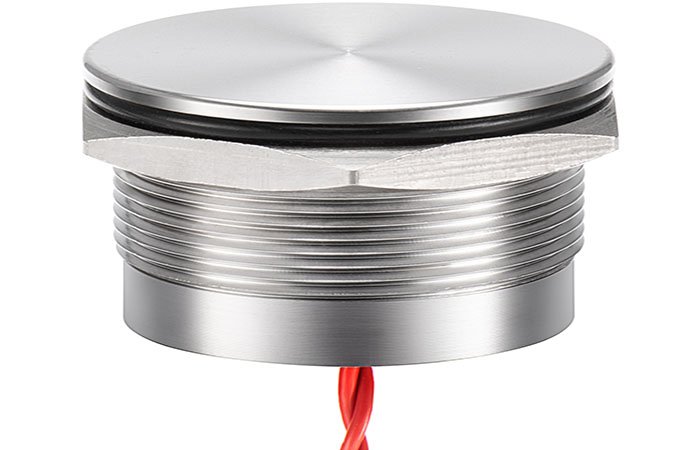
Piezo switches are highly durable. Under normal use and without damage, they have an exceptionally long service life. A high-quality piezo switch can withstand over 50 million actuations. This means if you press the piezo switch 1,000 times a day, it could last approximately 137 years. How impressive is that? The key to the long life of a piezo switch lies in its lack of physical contacts, which minimizes wear and tear. Additionally, they utilize special ceramic materials that maintain responsiveness even after hundreds of millions of presses. In daily life, you can find piezo switches in subway ticket machines, which continue to function accurately even after years of heavy use.
How Do I Know If My Piezo Switch Is Broken
Have you ever wondered if your piezo switch is working or broken? I will show you a few simple methods to check it yourself.
No response: The piezo switch can be pressed normally but does not respond. This may indicate that the internal ceramic is damaged.
Intermittent sensitivity: After pressing the switch, the piezo push-button switch sometimes works and sometimes does not. This could be due to moisture in the switch.
False activation: The switch activates on its own without being pressed. This may be caused by electromagnetic interference.
Test with a multimeter: If there is no change in voltage when the switch is pressed, it is time to replace it.
FAQ
What functions does a piezo switch have?
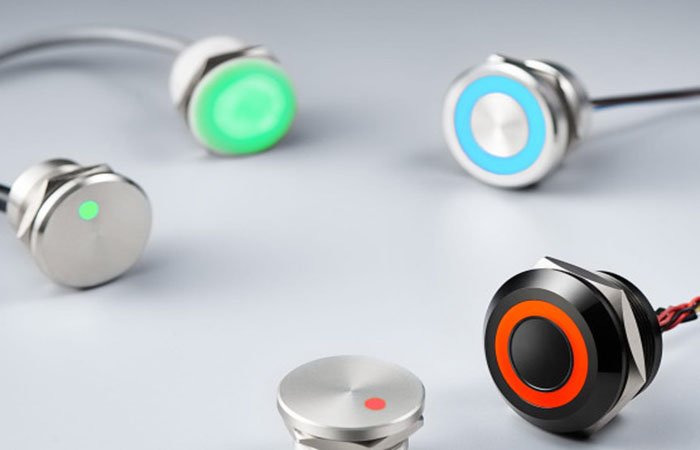
Piezo switches have functions such as illumination, waterproofing, NONC (normally open, normally closed), momentary action, latching, etc. Therefore, piezo switches are categorized into illuminated piezo switches, momentary piezo switches, and so on.
What is the difference between a piezo switch and a capacitive switch?
The main difference lies in the working principle: one is based on the piezoelectric effect, while the other is based on the principle of capacitance change.
What materials are piezo switches made of?
Common materials include stainless steel 316L, aluminum, and plastic materials.
 Russia
 English