
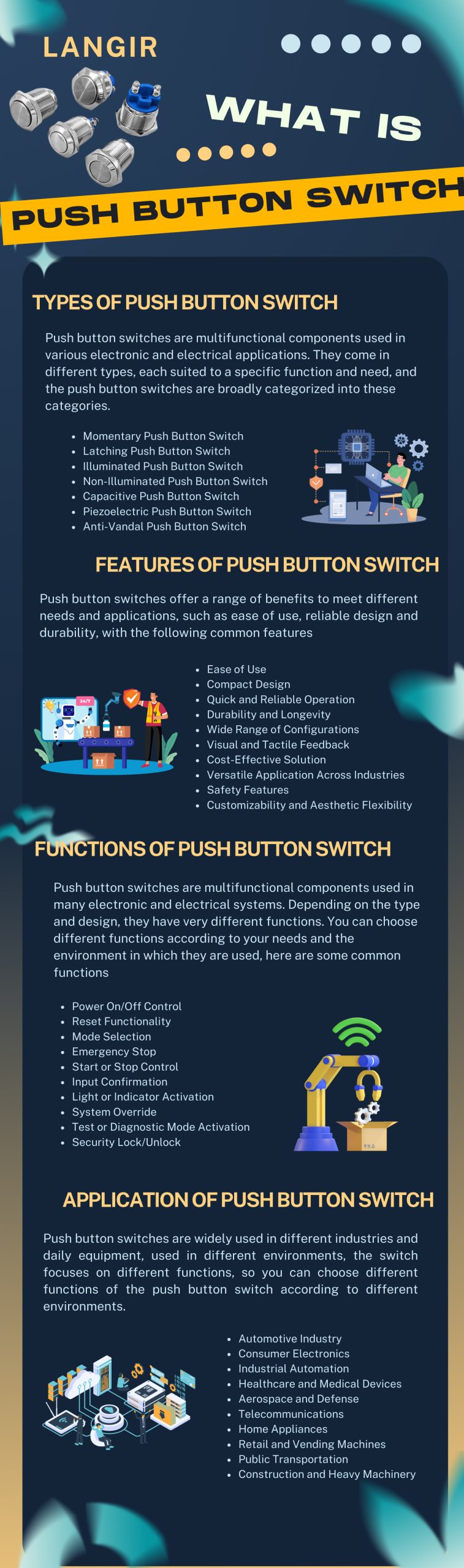
If you are very interested in A push button switch, this infographic can help you understand the information faster.
Types of Push Button Switches
There are many types of push button switches. Common types include momentary push button switches, latching push button switches, illuminated push button switches, non-illuminated push button switches, capacitive push button switches, piezoelectric push button switches, and vandal-proof push button switches, among others. Different types of switches have different functions.
Momentary switches and latching switches are opposites. A momentary switch changes state only while the button is pressed and returns to its original state when released. In contrast, a latching switch remains in its changed state after being pressed, even after the button is released, until it is pressed again to revert the state.
Capacitive and piezoelectric switches are touch-sensitive. Unlike other switches, they require minimal pressure to activate. Piezoelectric push button switches still need slight pressure, while capacitive switches operate with zero pressure.
Vandal-resistant switches are specially designed to withstand vandalism or harsh environments. Their high durability makes them suitable for use in most industries.
Features of Push Button Switches
Switches offer numerous advantages, which is why they are widely used across many industries.
The operation of a push button switch is very simple—typically just pressing the button. Some types are even simpler, such as touch-sensitive switches that only require a touch, or toggle switches that involve flipping a lever.
Push button switches feature a very compact design with a small footprint. Externally, only a metal housing is visible, which encloses numerous internal components that enable their various functionalities.
The switch activates or deactivates a function instantly upon button operation. The metal housing enhances durability, ensuring the switch operates quickly and reliably over time.
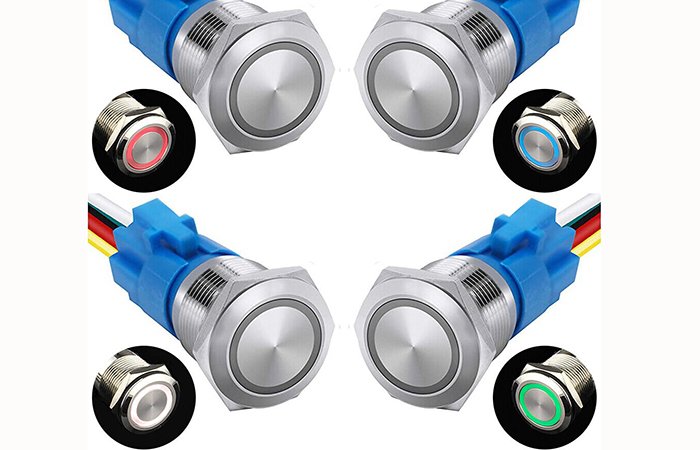
Switches provide distinct tactile feedback when pressed. Many also include illumination, offering both visual and tactile confirmation.
Switches can be customized with specific functions for particular environments, providing flexibility and adaptability that allows their application across diverse industries.
Functions of Push Button Switches
Switches perform many functions, leading to a wide variety of types that can be used in nearly all industries. Although small and seemingly simple, push button switches play a vital role.
Common everyday functions include power control (e.g., light switches), start/stop buttons for appliances, reset functions, mode selection, emergency stop (e.g., elevator emergency buttons), security locking/unlocking, and input confirmation (e.g., combination lock buttons), among others.
Applications of Push Button Switches
Given their powerful functionality, switches can be adapted to many industries and settings, such as automotive, aviation, and aerospace.
In automobiles, aircraft, or aerospace, switches are indispensable—for example, physical buttons on vehicle dashboards, or window and door controls. In industrial automation, such as fin stamping machines, function selection and other operations are achieved through switches. They are also used in medical equipment, where operation demands timeliness, cleanliness, ease of cleaning, and infection resistance—qualities that the switch's metal housing can provide. Of course, button switches are ubiquitous in household appliances as well, such as start buttons and function selection keys on washing machines, ovens, etc. In both industrial production and daily life, switches largely serve to bring convenience, improve efficiency, and reduce costs.
 Russia
 English