
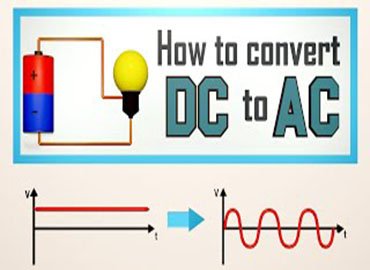
Electricity is the kingmaker of all electronic devices. Almost everything relies on different forms of electricity, whether it is alternating current or direct current. Electricity is available in AC form at home. However, devices like smartphones and chargers use DC voltage to charge themselves. How do we bridge the gap between AC and DC? This guide lifts the curtains from step-by-step conversion to AC to DC voltage conversion. Let’s eat some knowledge.
Understanding AC and DC
What is AC (Alternating Current)?
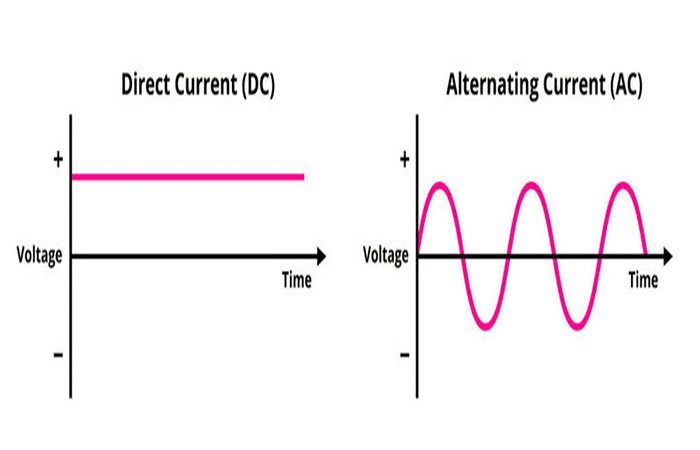
AC is a type of current that changes the direction of electrons periodically. For example, your AC operates at the 60Hz frequency. This means that the direction changes 60 times per second. Therefore, the Alternating current has a sinusoidal waveform that smoothly increases or decreases.
What is DC (Direct Current)?
Direct current is the opposite of alternating current. Instead of alternating the direction, the DC voltage flows in a single direction. The constant direction makes it easy to deploy in the delicate circuits.
Why is DC critical for modern devices and systems?
Alternating current changes direction and causes a surge of the current, damaging circuits and electronic components. The DC voltage comes with benefits:
- Consistency: The constant and surge-free current prevents damage to microelectronics.
- Compatibility: DC is compatible with many devices and helps operate smoothly.
- Battery power: All batteries have a single storage form— DC voltage!
Key Components in AC to DC Conversion
The process of AC to DC conversion isn’t a piece of cake. You keep your head straight and narrow to the following components for high efficiency.
Transformer
A transformer is a device that works only with the AC voltage. It steps up or down the AC voltage. There are two fundamental types:
- Step down the voltage: For example, it transforms 120V to 12V for small devices.
- Step up the voltage: A step-up transformer does it very well if you want to convert 110V to 220V.
Rectifier
Rectifiers are the game-changers. They work as the heart of the AC-to-DC conversion and transform the AC voltage into a smooth, constant voltage flowing in a single direction.
They use components called diodes! The diode arrangements and distribution divide rectifiers into three types.
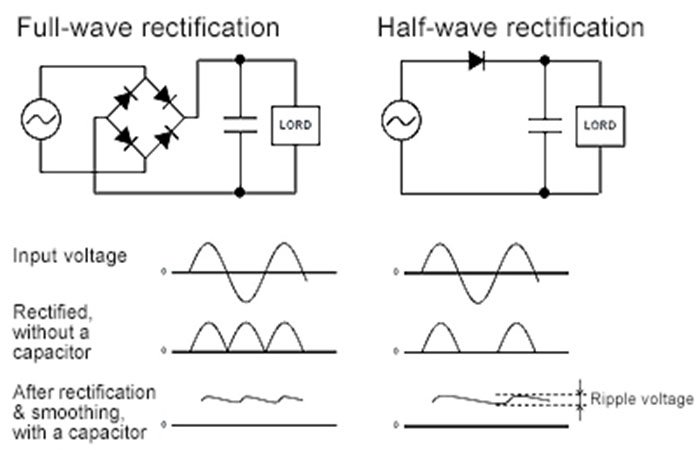
- Half-wave rectifiers use one diode that blocks only one-half of the waveform.
- Full-wave rectifiers place two diodes to rectify both halves of the waveform.
- Bridge rectifiers arranges four diodes in a bridge format and are the most efficient ones.
Filter (Capacitor)
Rectification doesn’t mean you get DC voltage flowing like water. It still has some ripples and needs treatment from filters.
- Capacitors store charge during voltage peaks.
- They reduce ripple voltage and give a constant DC waveform.
Voltage Regulator
Even after voltage filtration, there is still a need for regulations. The voltage regulator provides the final blow to peaks of voltages and makes the waveform constant and unidirectional. There are two types of regulators.
- Linear Regulators are plug-and-play and generate heat.
- Switching Regulators produce less heat but are more complex.
Step-by-Step Conversion Process
Once you have the right components, gear up for the final hit to get the DC output. We have discussed four steps to sum it up!
Step 1: Adjust the Voltage (Transformer)
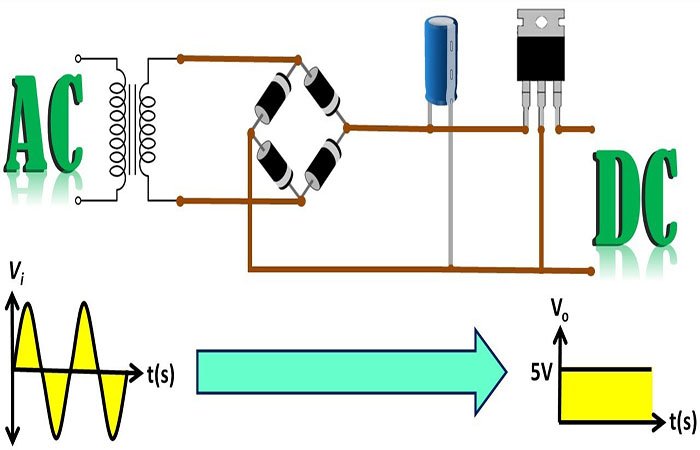
Let the transformers show off their magic tasks. For AC to DC conversion, feed a higher AC voltage to the transformers and get a lower voltage.
Why? Because many devices operate at a lower voltage. For example:
The mains Voltage is 120V or 230V AC. The transformer can be adjusted to 12V AC. Now the conversion game starts.
Step 2: Rectify the AC
We need the alternating current to be on a one-way street. Rectifiers take alternating voltage and convert it into pulsating DC.
Suppose you have a bridge rectifier. It does:
- Diodes only allow current to flow in one direction.
- A bridge rectifier harnesses four diodes to flip the negative half-cycles of AC.
Step 3: Filter the Output
The output from rectifiers looks like mountains and valleys. The capacitors help further smooth it.
Here is how it works.
- Capacitors harness the peaks of voltages and store current.
- The straightening of the waveform creates a smooth DC voltage.
Step 4: Regulate the Voltage
One last step is to regulate the DC voltage from the filters. A voltage regulator is the final gatekeeper. It performs the following functions with the DC voltage.
- Keeps the voltage steady as a rock.
- Prevents sudden spikes or drops
- Ensures consistent performance of electronic circuits.
Safety Considerations
Safety must be under your radar when you are transforming AC into DC. Here are a few tips to consider.
Use Proper Enclosures
Never leave your electrical circuits open. Why? Because they can catch fire and ultimately injure.
Go to the market and grab some enclosures. The features of the enclosure should be:
- Heat resistant
- Insulated
- Fire resistant
Enclosure is the first line of defense that keeps all the accidents miles away!
Check for Certifications
Certificates are the official ticket to safety. The most famous certificates include UL, CE, and FCC. They ensure the products have passed various tests and are ready to show off their skills in the electronic system.
Don’t Underrate Your Converter
Rating vs load is a top-class competition. If your converter power rating is lower, the chances of catching fire are high. On the other hand, get a converter with a higher power rating and can handle peak loads without causing much disturbance.
Account for heat
Power conversion causes energy losses in the form of heat. This heat can aggravate the system failure and might damage various components.
So, how do you riddle out this puzzle? Go for heatsinks, fans, or ventilation to cool down your system.
AC to DC conversion formula
The practical conversion of AC into DC is a hard nut to crack. You have to dive into various steps. But theoretical conversion is seamless. We mention the DC voltage as the root mean square of AC (AC RMS).
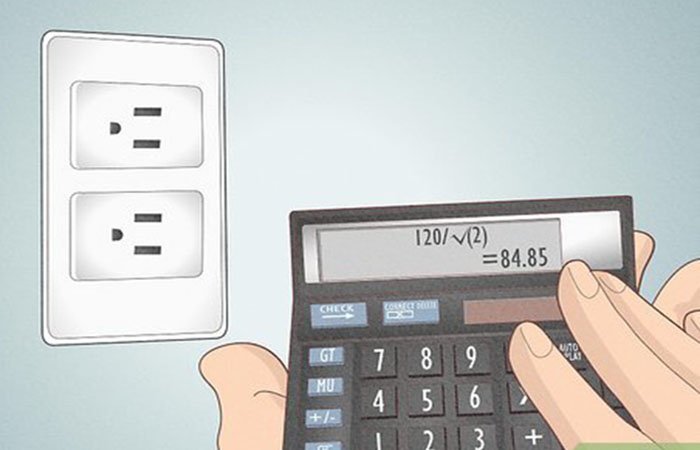
RMS for a standard AC waveform is equal to the peak voltage divided by the square root of two, as shown in this RMS to DC formula:
The conversion formula defines the DC voltage as the peak power divided by the square root of 2. RMS equation for AC to DC conversion:
RMS = Vp/√2
Example:
Suppose the peak AC voltage is 141 volts. The DC voltage will be:
RMS = 120/√2 = 84.85volts
So, the DC voltage is 84.85 volts.
Applications of AC to DC conversion
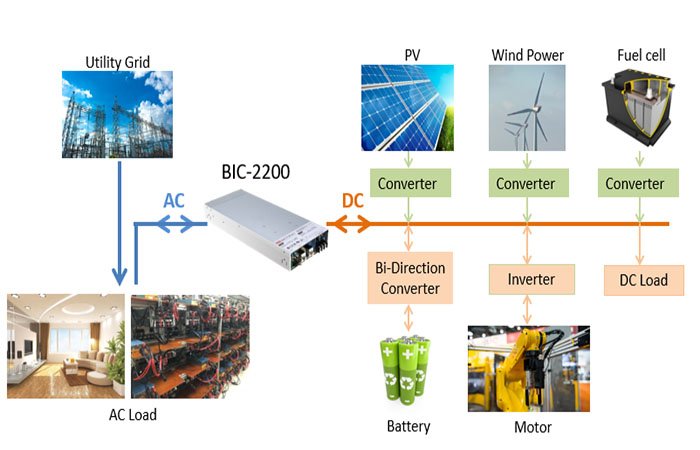
AC to DC conversions are everywhere you look. No spikes, seamless flow, and empowered storage keep the following devices running non-stop.
- Mobile chargers (convert wall AC to 5V DC for USB)
- Laptops and desktops (internal power supply units)
- LED lighting systems
- Battery chargers
- Home automation and smart devices
- Industrial control panels
- Medical and lab equipment
- Electric vehicles
Conclusion
AC to DC conversion lays the foundation of modern electronics. However, the conversion techniques can vary from simple to advanced systems. For example, the simple conversion methods still rely on the rectifiers, while the advanced technology has moved toward switch-mode power supplies.
Whatever tactics you use to fetch the AC to DC voltage conversion, ensure optimized safety. From the basic adapter to the complex power system, apply the fundamental principles of AC to DC conversions.
FAQs
Q1. Can an inverter convert ac to dc?
No, it can’t. Inverters are designed to convert DC (direct current) to AC (alternating current). For example, in a solar power system, a DC MCB (Miniature Circuit Breaker) protects the DC side, while the inverter converts the solar-generated DC electricity into usable AC voltage for homes or the grid.
Q2. Is DC voltage safer than AC?
Not necessarily, as DC voltage also poses injury risks when at a higher voltage. However, at lower voltages, it is safer than AC.
Q3. What will happen if you run DC-compatible devices on AC voltage?
First, the devices won’t run at all. If they do, they will crash immediately due to a continuous change in the current direction. Therefore, you can experience more accidents with wrong compatibility.
Q4. Can you convert DC back to AC?
Yes. If you have converted AC to DC, an inverter can help you reverse this process and transform the DC back to AC.
 Russia
 English