
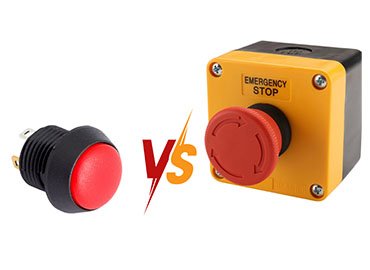
Push buttons and E-stop buttons are two of the most commonly used components in industrial and control systems, but what’s the difference between them, and when should you use one type of button over another? We’ll describe each, explain its most common uses, and lay down major differences in form, function, and regulation.
Push Button Switch
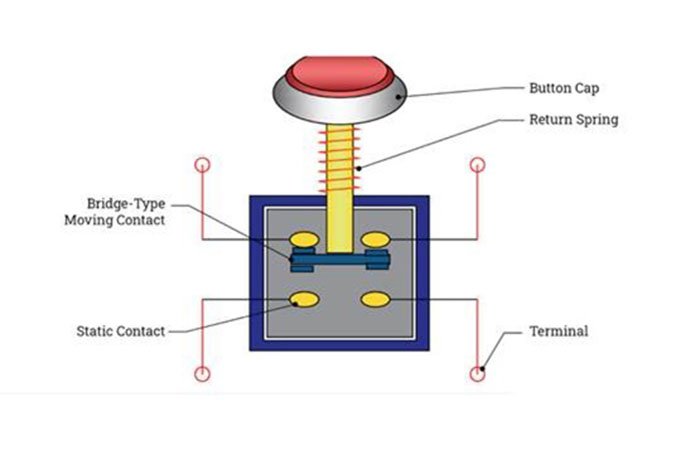
A push button switch is a switch that completes or breaks an electric circuit when actuated by pressing a button. It is used for momentary contact and is an input device.
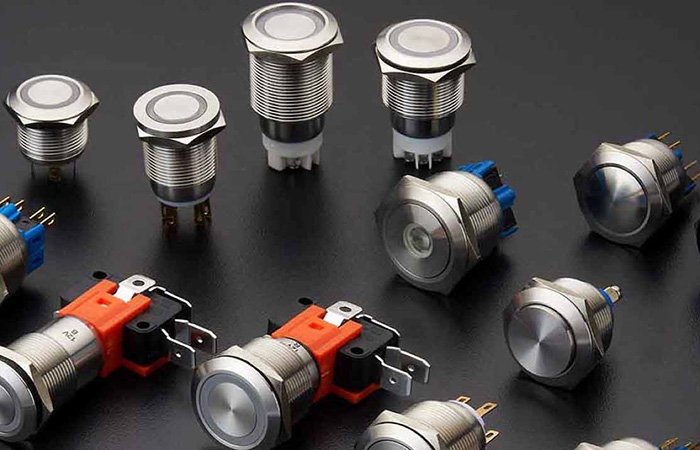
Types of Push Button Switches
- Momentary Contact: a switch that is turned on only as long as the button is held down (for example, a doorbell).
- Latching/Maintained Contact: The switch maintains actuated position unless acted upon again (for example, light switch).
- NO (Normally Open): contacts are open when at rest, and are closed when power is applied.
- NC (Normally Closed): closed when not pressed and open when pressed.
- Illuminated: contains built-in fluorescent light for checking status.
- Non-Illuminated: no built-in light.
Typical Applications
In the control panels used in industry, they are critical to tasks like starting and stopping motors, turning on conveyors and opening or closing valves. And beyond industry, they are key components of consumer electronics —there are on-off switches, volume control dials, input keys and the like. You’ll also find them in everyday household objects, including washing machines and microwaves, and in the automotive world, where they’re used for things like operating windows and pushing the horn.
Emergency Stop Button (E-Stop)
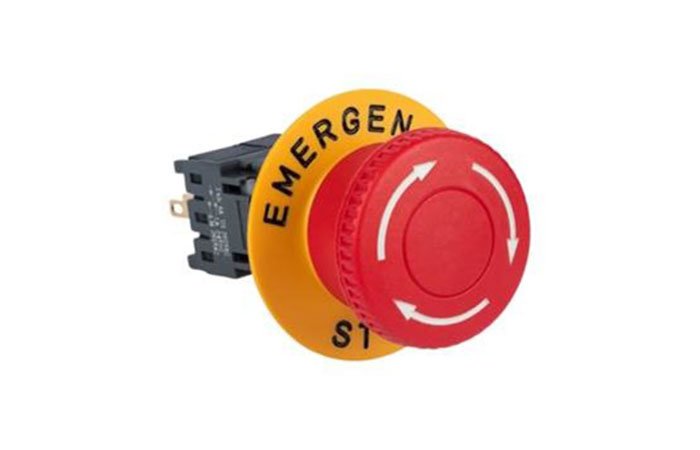
An E-stop button is a safety switch that is used to stop machines, equipment, or processes in control systems quickly and safely when an emergency occurs. It exists simply to manage the risk and to reduce the chance of damage or injury by forcing equipment to be in a safe state as fast as it can. It’s an impromptu action to prevent a dangerous situation.
Key Characteristics and Design Principles
E-Stop buttons have certain safety functions:
- Dominant Color and Shape: Usually red, mushroom-shaped and easily recognizable.
- Latching: Once pushed, the button will hold until it is manually reset to make sure the dangerous condition is being acted upon.
- Positive Breaking Contacts: If contacts stick together during a fault condition, the E-Stop mechanism forcibly opens them, breaking the circuit. This is an important safety aspect.
- Tamper-Proof: Not easily activated or deactivated.
- Fail-Safe Construction: Designed to return to the off position when valve is shut down, even if the actuator fails.
Standards and Regulations
E-stop buttons are regulated by tough international and national safety standards, such as ISO 13850 (EN 418), IEC 60204-1, and OSHA regulations. These requirements define the structure, location, and operation to be followed in limiting the scope as they are of most value in the event of a disaster.
Emergency Stop Button Applications
E-stops are required in applications where machinery might present a hazard. Examples include:
- Factories: both robot arms and heavy machinery on production lines.
- Conveyors: for instant disabling of travel in the event of an entanglement or an unusual condition.
- The automated warehouse: forklifts and AGVs.
- Process industries, chemical plants, power plants.
- Machine Tools: lathes, mills, presses.
Push Button Switch VS Emergency Stop
| Feature | Push Button Switch | Emergency Stop Button |
| Design/Appearance | Colorful, usually hard and flushed | Unique red mushroom head, yellow background |
| Latching Mechanism | Optional (momentary or maintained) | Presses in and latches must be manually reset |
| Contact Operation | Standard NO/NC contacts | Guaranteed for circuit break opening with positive contact |
| Reset Mechanism | Automatic (momentary) or manual (maintained) | Hand reset (twist, pull, key) to force safety check |
| Regulatory | General electrical safety | International establishment stiff safety standards and regulations (ISO 13850) |
Design and Appearance
E-stops are distinctive in appearance to promote rapid identification and fast in emergency situation access. Pushbuttons are available in a broader range of designs, allowing for both aesthetic and functional integration.
Latching Mechanism
E-stops require latching. Otherwise, they will only hold the safe state until the operator is distracted and lets go, then it will fire up. Also, normal push buttons can be latching or non-latching depending on the intended application.
Contact Operation
On an E-stop «positive opening contacts» are a safety must. They ensure the circuit will break regardless of the welding of the contacts under heavy loads or fault conditions, which is not required with regular push buttons.
Reset Mechanism
An E-stop has a manual reset and it takes effort to reset, so it makes the operator consciously acknowledge the problem before they resume operating. This eliminates the ability to turn a potentially hazardous system around immediately.
Regulatory
E-stop buttons are required by law (as a safety thing) in many industrial places, for very specific reasons. Push button switches are under a general electrical safety code, not the same type of safety-specific regs as E-Stops.
Correct Selection and Installation
Choosing the right part and getting it installed properly is essential, and here are a few factors to consider.
Safety Compliance
First and foremost, ensure that the E-Stop buttons are designed according to the applicable international and local safety criteria. Wrong selection may cause serious accidents and legal consequences.
Operational Efficiency
As much as safety first, you should also be thinking about the practical side of things. For easy access, a push button for controlling the pump ensures ease of use and handling.
Maintenance and Testing
Regular testing of E-Stop buttons is absolutely vital if they are to operate properly in the event of an emergency. This most frequently includes periodic functional tests, as implemented in a comprehensive safety program plan. Even the push buttons need to be maintained for their reliability. However, if they do fail, at least the damage is less dramatic.
Conclusion
The push button switch is different from an emergency stop button in terms of function, structure, and standard. Both of these elements are crucial in control systems, and confusing one for the other, or using them incorrectly, has potentially disastrous consequences including operational inefficiencies or catastrophic safety incidents. Knowing these differences and adhering to the correct selection and installation practices is key to ensuring safe and efficient industrial facilities.
FAQs
- Can E-stops be wireless?
Wireless E-stop buttons actually exist, and they are used in various industrial environments. They take good care of machines from a distance, without risking danger beyond safety standards and compliance transmission.
- Is it a bad idea to use an emergency stop button for power, and if not, how?
You shouldn’t use an emergency stop button as a power button. E-stops are not to be used as a regular event for cycling equipment on and off.
- Can I use a general-purpose pushbutton switch as an E-Stop push button?
No, push buttons cannot be used as emergency stop devices. Emergency stop devices must meet certain safety requirements, but ordinary push buttons do not meet these requirements.
- What does «positive opening contacts» mean with reference to an E-stop button?
«Positive opening contacts» describes a failsafe type of mechanical arrangement where the contacts are opened by the motion of the actuator that opens the circuit, such that even then they cannot weld during a fault. It is an essential safety feature of any true E-stop product.
 Russia
 English